
O-H · overcoming
The Problem Solver

You have a hacker's instinct for finding and fixing what is broken. Your energy flows from creative intelligence into challenging authority, breaking rules, and solving problems that stump everyone else. You don't accept things just because 'that's how they've always been done.'
Key Takeaways
✦You have a physiological sensitivity to systemic flaws — you see the loopholes and inefficiencies others miss.
✦You do not obey authority out of rebellion; you disobey because you can see the logical fallacies behind the rules.
✦Your drive is truth-seeking — the pleasure of cracking a hard problem is the purest reward.
✦The risk is over-reliance on pure logic — reality includes random, emotional, and unknowable variables that no logical framework can fully capture.
What This Feels Like
- You cannot follow a stupid rule without feeling physical discomfort. Compliance without understanding is agony.
- You naturally deconstruct problems: break them down, find the root cause, rebuild from first principles.
- You need hard problems to feel alive. Without a challenge, your energy turns into restlessness or anxiety.
- Your inner monologue: "What is the underlying rule here? Can I find a better way?"
- You respect competence, not credentials. A brilliant idea from an unknown person matters more than a mediocre one from an expert.
Career Paths
✓ Likely a good fit
Engineering & software developmentData science & analyticsResearch & developmentManagement consulting (problem-solving track)Cybersecurity & ethical hackingScientific researchStrategy & operationsEntrepreneurship (product-focused)Investigative journalism
✗ Likely a poor fit
Strictly procedural roles with no autonomyBureaucratic environments that punish questioningRoles requiring constant deference to authorityJobs with repetitive tasks and no intellectual challenge
In Relationships
In the outside world, you are decisive and results-driven — using your talent to crack hard problems. But in relationships, you let down your guard and enjoy being cared for. You do not seek a partner who outpaces you in career achievements; what you value is genuine emotional connection over worldly success. The challenge is that your vulnerability can turn into actual weakness — you may become overly dependent in relationships, losing boundaries and shifting from an active problem-solver to a passive waiter.
Not Every The Problem Solver Is the Same
Having The Problem Solver pattern does not mean you are always difficult or contrarian.
It does not mean you cannot work within systems — you just need to understand why the rules exist before following them.
It does not mean you lack emotional intelligence — many Problem Solvers learn deep empathy through understanding human systems.
It does not guarantee that every problem you solve leads to success — some problems persist because they serve a purpose beyond logic.
The Problem Solver vs The Innovator
| Dimension | This Pattern | The Innovator |
|---|---|---|
| Energy Flow | O - H (Output - Authority) | O - I (Output - Input) |
| Relationship to Systems | Challenges authority — builds own structure, proactively solves systemic problems | Challenges knowledge — absorbs and innovatively recombines existing knowledge systems |
| Problem Style | Structural thinking — deconstructs problems, rebuilds own framework | Synthetic thinking — cross-domain knowledge integration and creative recombination |
| Risk | Overconfident in own logic and structures, ignores human factors embedded in existing systems | Broad but shallow — knows a lot but lacks true depth in any one field |
Decision Guide
If you are a Problem Solver, your strength is cutting through complexity to find elegant solutions. You see what others cannot. What you need is humility before the non-logical — accepting that not everything in life is a puzzle to be solved. Some things must be felt, respected, or simply lived through. The best Problem Solvers learn when to set aside their tools and just be present.
See this pattern in comics
View all comics →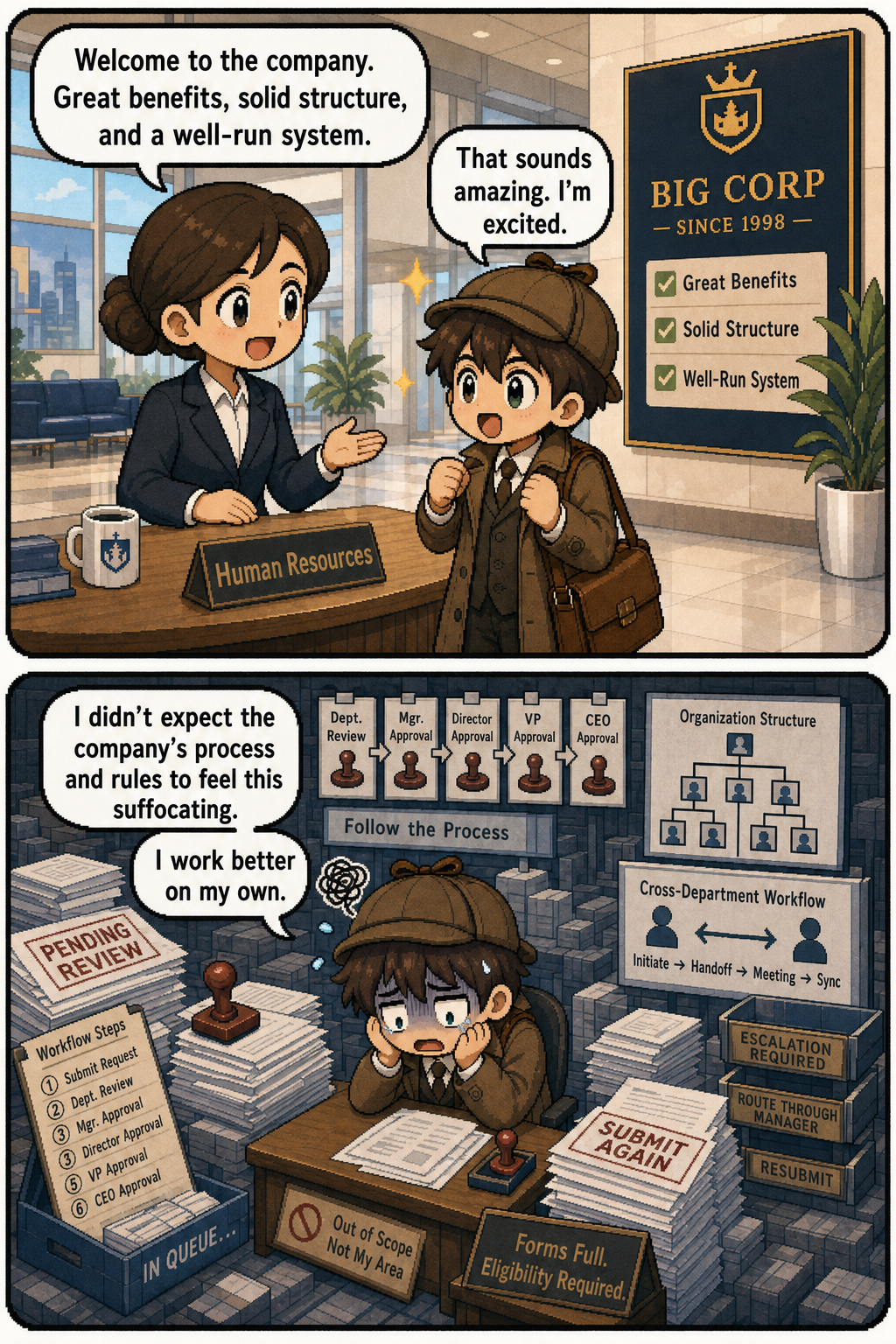
Disclaimer: Ba Zi is a personality framework for self-reflection, not a substitute for professional medical, financial, or legal advice. All patterns describe tendencies, not destinies.