
H-O · counter
The Hamlet

You always hold a standard higher than reality. You know how things should be done, and you easily notice the distance between that standard and what actually exists. Even when nothing seriously wrong is happening, you may automatically enter a state of not good enough yet, can't fully relax. This is not pessimism — it is a rare quality-awareness. When your careful deliberation finally produces output, it carries a precision and reliability that hasty work could never reach.
Key Takeaways
✦You hold persistently high standards for yourself — even when no one demands it, you naturally expect yourself to do better.
✦You naturally notice the gap between standard and reality — others see completion, you see what still needs improvement.
✦Your caution comes from high sensitivity to errors and consequences — this makes you reliable, but raises the threshold for action.
✦Your strength is quality control; your cost is that it is hard to truly feel "enough, I can relax now."
What This Feels Like
- It is actually pretty good, but I know it could be better.
- Wait a bit more — I want to make sure there is nothing wrong.
- An 80-point result: others see completion, you see the remaining 20 points.
- The more important something is, the more cautious you become, because the harder it is to accept it going out of control.
- Even when things are going well, you may suddenly think: Will it really stay this good?
- You are not constantly pessimistic — you just cannot long-term shut down the part of you responsible for checking risk.
- Sometimes the most exhausting thing is not reality itself, but that you can never fully stand down from alert.
Career Paths
✓ Likely a good fit
Risk managementQuality control & testingEngineering safetyHealthcareLawAuditingResearchStrategic planningEditing & proofreadingSystem designProfessional consulting
✗ Likely a poor fit
Environments emphasizing rapid trial-and-error and rough launches while demanding high-quality resultsHigh-speed execution roles with no room for careful judgment
In Relationships
When you feel the relationship is safe and trustworthy, you can naturally express, attach, and enjoy intimacy. But when your inner reviewer comes online, immersion is easily interrupted. Your awareness retreats from 'I am loving this person' to 'Is this relationship really reliable?' This detachment does not mean you no longer love — it is more like experience mode temporarily yielding to evaluation mode. The more important it is, the more seriously you take it; the more seriously you take it, the more you cannot let your guard down. What you truly need to learn is not forcing yourself to believe in love, but distinguishing: Am I seeing a real problem, or am I constantly demanding the relationship prove it is absolutely safe because I cannot tolerate uncertainty?
Not Every The Hamlet Is the Same
It does not mean your reality is necessarily painful — pressure can come from internal standards, not external disasters.
It does not mean you lack ability — precisely because you are highly capable, you can see the shortcomings.
It does not mean you lack the power to act — you simply need more certainty before you are willing to start.
It does not mean you do not believe in love — you can be deeply invested; risk awareness simply makes you switch into evaluation mode.
It does not mean detachment means feelings have disappeared — it may simply be the protective mechanism coming back online.
It does not mean high standards must be eliminated — they are the source of your quality sense; what needs adjusting is recognizing that not everything deserves a 100-point standard.
The Hamlet vs The Problem Solver
| Dimension | This Pattern | The Problem Solver |
|---|---|---|
| Core | Standards review method | Method solves problem |
| Core Question | Is this really good enough? | How do I solve this? |
| Action | Cautious, then acts | Judges, then breaks through |
| Standards | High | Serves problem-solving |
| Perfectionism | Reaching-standard type | Results type |
| Main Strength | Risk control, quality | Problem-solving |
| Main Risk | Self-review, difficulty relaxing | Over-trusting own approach |
| Facing Relationships | Tends to evaluate reliability | Tends to address practical issues |
Decision Guide
Your high standards are not the enemy. What truly exhausts you is that everything is placed into the same set of high standards. What you truly need to build is not lower standards, but different tiers of standards: some things must be 90 points, some things are worth starting at 60 points, some emotions do not need to be resolved, and some uncertainties in relationships cannot be eliminated. Authority teaches you to be responsible for reality; Output reminds you that life also needs to be personally experienced.
See this pattern in comics
View all comics →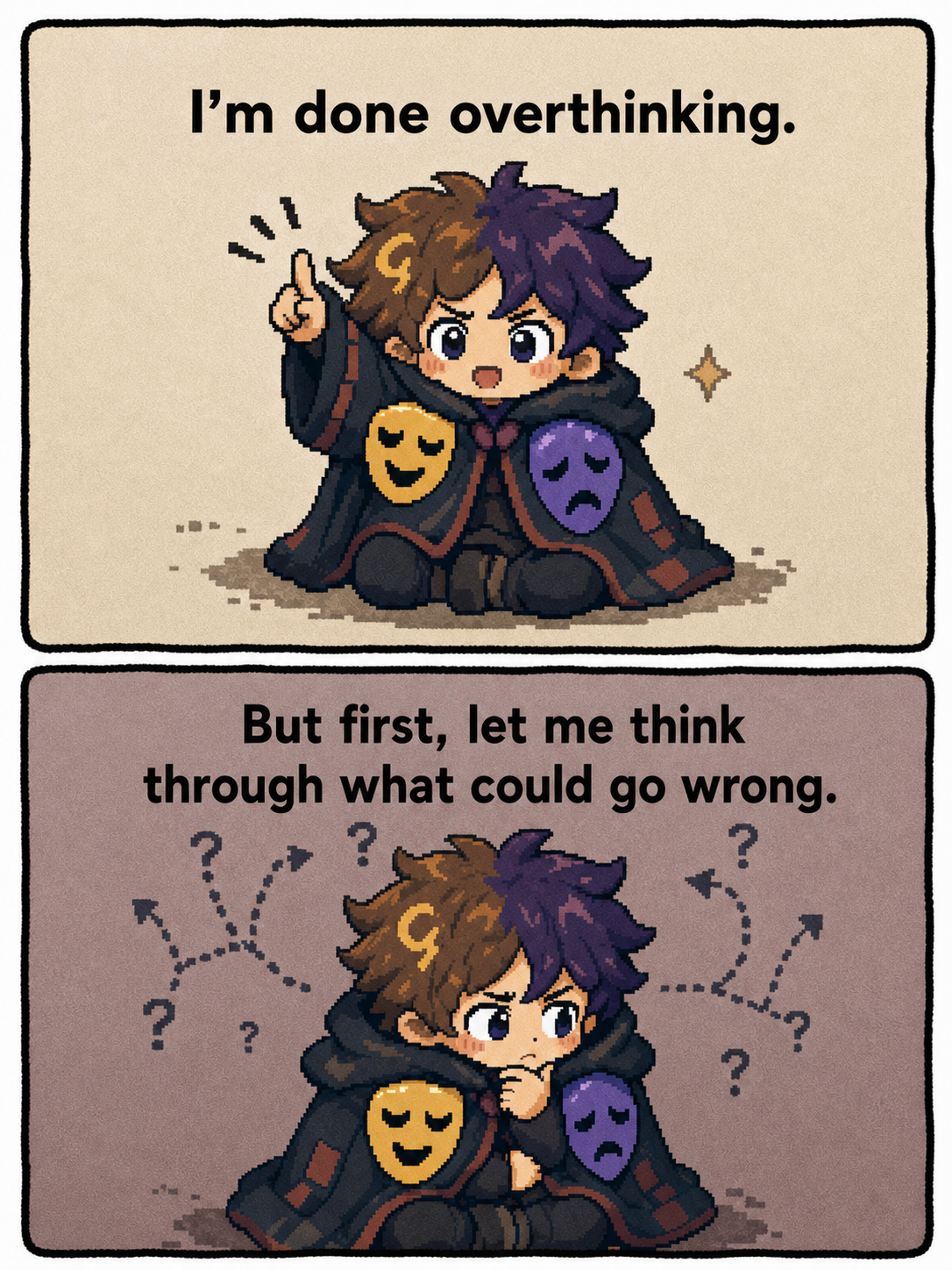
Disclaimer: Ba Zi is a personality framework for self-reflection, not a substitute for professional medical, financial, or legal advice. All patterns describe tendencies, not destinies.